Also, Manfred Weber’s balancing act
undefined
By Eddy Wax
 
undefined
with Nicoletta Ionta
 
Supported by     European Hydrogen Week


You’re reading Rapporteur AM on Monday 12 October.

Need-to-knows:

  • Marine Le Pen piles pressure on EU budget timeline

  • Consensus builds to restrict Russian visas

  • Weber’s inner circle fights for top jobs


On the roundabout: Why OLAF should be renamed

 
Supported by Petcore Europe
PET trays keep food fresh, reduce waste & extend shelf-life

The PET trays that package our meat, cheese, fish, fruit and vegetables are fully recyclable. They offer a circular, food preserving solution that enhances shelf life and allows farmers, fisherman and food producers to bring their goods to market unharmed. Find out more

rapporteur From the capital
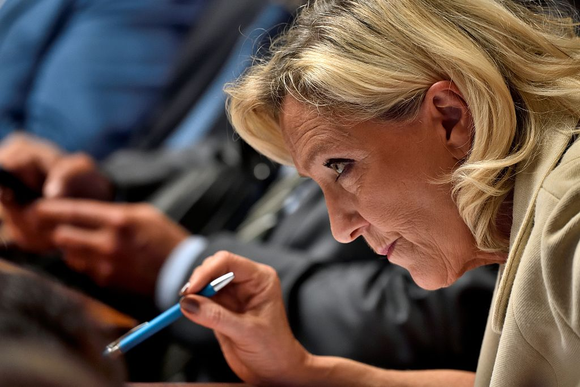
Marine Le Pen [Thierry NECTOUX/Gamma-Rapho via Getty Images]


Marine Le Pen will thrust herself into the race to agree the next EU budget when she travels to Brussels on Wednesday. 

At a press conference a day before the EU summit, the presidential candidate is expected to lay out her plans for halving the French contribution in fresh detail if she wins next May. 

“They want to make the deal before the presidential election because they know that something might be changing,” a Rassemblement National official told Rapporteur.

Luckily for Le Pen, after Ireland put out its much-anticipated compromise proposal on Saturday, the prospect of a quick-and-dirty deal does not appear any closer.

Dublin proposed hacking 8% off the Commission’s proposal, tantamount to €159 billion, mostly in spending on competitiveness, foreign policy and the EU institutions, my colleague Victoria Becker reported.

Under the Irish proposal, the seven-year spending plan would still be substantially larger than the current one.

The reactions on Saturday were predictable, if not inevitable: Germany, Sweden and Austria all shot it down. Behind closed doors at a Sunday Coreper discussion, ambassadors trotted out the same arguments they’ve been making for months, several diplomats told Rapporteur.

Friedrich Merz’s negotiating stance is that there will be no deal – and certainly not by Christmas – without steeper cuts. 

His nein adds to a mounting sense that reaching a deal by the end of the year will now be impossible, even though we have four summits to go until Christmas.

The two EU camps – the spendthrifts and the belt-tighteners – are only getting more deeply entrenched. It is, after all, a negotiation, and there are still at least two months to go. 

Le Pen’s Brussels trip will concentrate minds – especially for EU officials whose jobs would be at risk if she turned off the money taps. 

But whether it forces movement at this stage of the talks appears unlikely.


Russian visa squeeze

EU countries are warming up to curbing Russians’ freedom to enter and travel around the bloc, according to multiple diplomats. 

The EU executive is expected to propose targeted visa restrictions early next year to address security threats from non-EU countries.

The bloc’s foreign ministers will discuss the matter in Luxembourg today. “There is readiness to scrutinise this more,” said a senior EU official. A decision won’t, however, be taken today.

Three categories of Russian citizens are being looked at: tourists, former combatants, and diplomats, often suspected of being intelligence agents. Tighter measures on tourists have long been resisted by France and Italy, who welcome the largest numbers. France now, however, seems to be ready to move. 

Ideas under consideration include limiting Russian diplomats to travelling only within the country they are posted to, or obliging them to obtain the authorisation of the host and destination countries in order to travel.

Other EU diplomats said that determining who qualified as a combatant still poses legal problems, and pointed to a political risk of tarring an entire country’s people with the same brush.

Twinning the war

Can twinned towns remain friends when their countries are not? Russia’s war in Ukraine has forced hundreds of European municipalities to answer that question. 

My colleague Martina Monti reviewed all the 272 cities in the EU which had official ties to their Russian counterparts when the full-scale invasion took place. Some cut them; others kept them. For the majority, it is not even clear what remains.

Read the full story here.

Manfred Weber’s Greek drama

The EPP jets off for Taormina, Sicily today, a place that boasts one of the world’s best-preserved ancient Greek theatres. It’s an apt setting for the three days of strategic talks, set to be graced with on-stage appearances from Ursula von der Leyen, Roberta Metsola and Antonio Tajani. 

A fight for 10 vice-chair positions among the 184-strong group is kicking off in earnest, ahead of a vote in Strasbourg on 20 October. MEPs expect plenty of backroom lobbying outside the official programme.

The candidacy of Portugal’s Sebastião Bugalho has thrown the contest wide open. It came as a surprise to Weber that Lídia Pereira, the current Portuguese vice-chair, would clear the way for Bugalho. And it creates a gender-balance problem. 

The problem could be solved if Eszter Lakos, the Hungarian MEP, manages to knock out Bugalho and succeed Pereira. In that scenario the six current male vice-chairs would also be safe. But none of the ten-strong presidency – who help Weber lead the parliamentary work – is guaranteed to survive. 

Read the full story by Pietro Guastamacchia and me.

Caution reigns after Hague sanctions

EU countries are reluctant to pull the trigger on the ‘blocking statute’ in response to Donald Trump’s announcement of sanctions against the International Criminal Court, multiple diplomats said.

The EU law would bar European companies and individuals from complying with foreign sanctions. Brussels last triggered it when the US pulled out of the Iran nuclear deal.

The Commission and capitals have suggested there is an opportunity to convince the Americans to back down during the six-month window before the US measures take effect. 

Maxime Prévot, the Belgian foreign minister, is pushing to activate it at a meeting in Luxembourg today.  “We will press for concrete protection. The Court’s independence cannot depend on whom it investigates,” he said on Friday. 

Here are three new stories from Rapporteur:

 
Advertisement
Petcore Europe
rapporteur Schuman roundabout


LET IT GO: OLAF, the EU’s anti-fraud office, should be renamed – because it sounds too much like a Disney cartoon snowman, according to a proposal by Daniel Freund, a German Green deputy.

Olaf is a cuddly animated character from the children’s musical Frozen. OLAF is the EU’s anti-fraud office. (The acronym comes from the French Office européen de lutte antifraude).  The name should change to “better reflect the seriousness of its mandate,” Freund wrote in an amendment to a parliamentary report.

He suggested APEX (Anti-corruption Prevention and European Examination Service), or FORT (EU Financial Oversight and Recovery Taskforce). 

The report is going through the unfortunately named CONT committee, which could also do with a rebrand.

 
rapporteur The capitals


🇫🇷 PARIS

MEP Raphaël Glucksmann on Sunday won the Social Democrats' presidential primary with 66% of votes, cast by nearly 120,000 participants. He secured the endorsement of the historic Socialist Party and also the financial muscle of one of France’s wealthiest parties. Glucksmann’s battle is only beginning: he must now ensure he has the backing of his defeated rivals, while the far-left Jean-Luc Mélenchon pursues his own presidential bid and retains a polling edge.

– Elisa Braun

🇵🇱 WARSAW

Polish police arrested a man suspected of planning to assassinate Donald Tusk, the Interior Minister Marcin Kierwiński announced on Sunday. Authorities received intelligence about a possible attack targeting both Tusk and Defence Minister Władysław Kosiniak-Kamysz, prompting an emergency meeting involving police, government protection officers and domestic intelligence officials. Tusk confirmed the arrest, thanking police for their swift response. Authorities have not disclosed the suspect’s identity or further details of the alleged plot.

– Charles Szumski

🇸🇪 STOCKHOLM

Magdalena Andersson, the Social Democrat leader, faces mounting pressure to form a government amid continued deadlock. She will report to the parliamentary speaker on Monday, with talks between the Centre and Left parties still at an impasse. The speaker could force a parliamentary vote on her candidacy as early as Wednesday, even without a coalition agreement, to break the deadlock. A prime ministerial candidate is approved unless at least 175 MPs vote against them. Four failed votes would trigger a snap election.

– Charles Szumski

🇩🇪 BERLIN

It remains unclear whether Die Linke will succeed in installing Elif Eralp as the party’s first mayor of the capital. Potential coalition partners, the SPD and the Greens, demanded a procedure for responding to antisemitic outbursts by members of Die Linke. Meanwhile, senior Linke party figures have come under scrutiny over their close ties to criminal syndicates, after photographs emerged showing the head of a criminal clan as well as influential Hamas supporters at Die Linke’s election-night party.

– Björn Stritzel

🇺🇦 KYIV

Volodymyr Zelenskyy rejected Donald Trump's call for a change of leadership on Sunday, insisting that only Ukrainians could choose their president. “With all due respect to President Trump, it is up to our society, our people, to choose their leader,” Zelenskyy told ABC. He renewed his call for a 60-day ceasefire with Russia, arguing that a pause in fighting would allow Ukraine to hold elections. Trump said on Saturday that Ukraine needed a new president to end the war, and blamed Zelenskyy for high diesel prices in the US.

– Charles Szumski

🇸🇰 BRATISLAVA

Slovakia has quietly restored military ties with Russia, honouring a pledge Robert Fico made to Vladimir Putin in May. Bratislava has already dispatched two military attachés to Moscow, while a senior Russian naval officer is expected to be posted to Slovakia. Opposition politicians warn that the move could leave the country more vulnerable to Russian espionage and influence operations.

– Natália Silenská 

🇷🇸 BELGRADE

Serbia has yet to invite the European Parliament team to observe its elections. ODIHR (of the OSCE) is already on the ground, while PACE (of the Council of Europe) has been invited, making the European Parliament a significant omission. When the Parliament last sent a delegation to Serbia in January, President Aleksandar Vučić refused to meet its members, who were hounded by pro-government tabloids.

– Bronwyn Jones

 
rapporteur Today's newsletter was brought to you by


Contributors: Victoria Becker, Thomas Moller-Nielsen, Pietro Guastamacchia, Bruno Waterfield, Elisa Braun 

Editors: Orlando Whitehead, Sofia Mandilara, Charles Szumski

 
Rapporteur
Copyright © 2026
Euractiv Media BV, All rights reserved.
Rapporteur - Boulevard Charlemagne 1 - Brussels 1041 - Belgium